Use load tables and span calculators based on ASTM D3916 to size FRP grating: pick panel depth and bearing spacing so the allowed load covers your live + dead load with deflection under limit.
- Best for: engineering sizing of FRP grating spans
- Specify when: load class and deflection limit must be proven
- Key spec: ASTM D3916, design load vs bearing span table
1. Engineering Principles & Design Standards
FRP grating design follows ASTM D3916 (pultruded shapes), EUROCOMP design code, and FGMC (Fiberglass Grating Manufacturers Council) guidelines. Key design considerations: allowable stress design (ASD) with safety factors, deflection limits (typically L/200 for floors, L/240 for sensitive areas), creep analysis for long-term loads, thermal effects, and connection design. Unlike steel, FRP is orthotropic (different properties in different directions), so bidirectional molded grating has equal strength in both directions, while pultruded grating is strongest in the bearing bar direction. Safety factors: 2.5-3.0 for ultimate strength, 1.5 for serviceability (deflection).
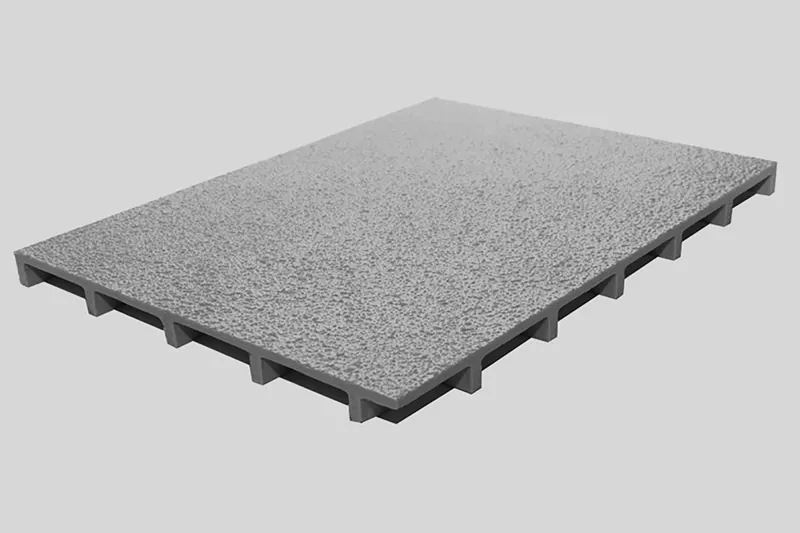
2. Molded Grating Load Table (38mm, 38×38mm mesh, Isophthalic)
Span 600mm: Uniform load 5.0 kN/m², Point load 1.5 kN, Deflection <3mm, Safety factor 3.0. Span 800mm: Uniform load 4.0 kN/m², Point load 1.2 kN, Deflection <4mm, Safety factor 3.0. Span 1000mm: Uniform load 3.5 kN/m², Point load 1.0 kN, Deflection <5mm, Safety factor 3.0. Span 1200mm: Uniform load 2.5 kN/m², Point load 0.8 kN, Deflection <6mm, Safety factor 2.8. Span 1500mm: Uniform load 1.8 kN/m², Point load 0.5 kN, Deflection <8mm, Safety factor 2.5. Note: Values are for pedestrian/light industrial use. Heavy-duty applications require 50mm grating or pultruded grating. Vinyl ester resin has similar load capacity to isophthalic.
3. Molded Grating by Thickness Comparison (at 1000mm span)
25mm (light duty): Uniform 1.5 kN/m², Point 0.5 kN, Weight 10-12 kg/m², Best for: drainage covers, light walkways. 30mm (medium): Uniform 2.5 kN/m², Point 0.8 kN, Weight 13-15 kg/m², Best for: general walkways, ramps. 38mm (standard): Uniform 3.5 kN/m², Point 1.0 kN, Weight 15-20 kg/m², Best for: industrial platforms, standard applications. 50mm (heavy duty): Uniform 5.0 kN/m², Point 1.5 kN, Weight 22-28 kg/m², Best for: heavy traffic, forklift areas, large spans. Mini mesh (19×19) has approximately 15% higher load capacity than standard 38×38 mesh due to more material per area.
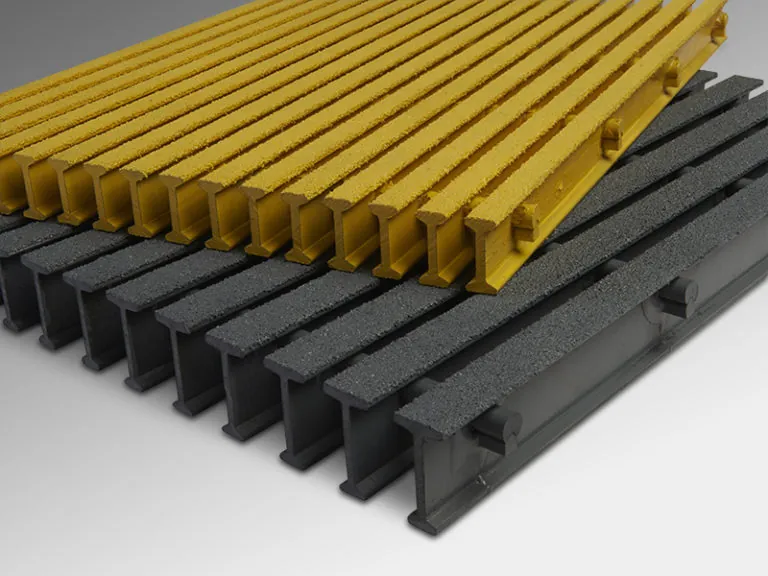
4. Pultruded Grating Load Table (50mm I-bar, 38mm spacing)
Span 1000mm: Uniform 25 kN/m², Point 5.0 kN, Deflection Deflection limits are critical for user comfort and safety. L/200 (e.g., 5mm at 1000mm span): standard for industrial floors, acceptable for most users. L/240 (4mm at 1000mm): recommended for offices, areas with sensitive equipment, or where users perceive deflection as "unstable." L/300 (3.3mm at 1000mm): premium feel, recommended for public areas, retail, or where vibration sensitivity is high. Excessive deflection (>L/150) can cause user discomfort, fatigue, and perception of instability even if structurally safe. For dynamic loads (walking, running), multiply static load by 1.5 for impact factor. Step 1: Determine support spacing (span) — measure distance between support beams. Step 2: Determine required load — pedestrian (3 kN/m²), light industrial (5 kN/m²), heavy industrial (10 kN/m²), forklift (25+ kN/m²). Step 3: Check load table — find thickness that meets or exceeds required load at your span. Step 4: Check deflection — ensure deflection is within acceptable limit (L/200 or L/240). Step 5: Consider environment — select resin based on chemicals, temperature, UV. Step 6: Consider surface — grit top for wet/oily areas, concave for standard, smooth for clean rooms. Step 7: Request engineering calculation for spans >1500mm or loads >10 kN/m². ZEALL provides free structural calculations with every quotation. All load, span and capacity values in this article are typical/indicative, derived from laboratory tests per NAAMM MBG-01 (FRP Grating Design Manual) methodology. Molded grating values apply a 5:1 factor of safety on ultimate capacity; pultruded grating values apply a 3:1 factor of safety, both measured at static ambient conditions. Impact loads are limited to 50% of stated values; long-term loads require creep adjustment per ASCE Structural Plastics Design Manual. Certified load tables, stamped engineering calculations and third-party test reports are available on request. For structural sizing of your specific application, contact our engineering team with your load requirements, span and environmental conditions — we provide free structural calculations within 24 hours. Browse our molded grating and pultruded grating product pages for full specifications and resin options. The table below consolidates typical allowable uniform live loads for molded isophthalic / vinyl-ester grating at a deflection limit of L/200, with a 5:1 factor of safety on ultimate capacity. Values are typical/indicative per NAAMM MBG-01; certified load tables are available on request. Typical/indicative values per NAAMM MBG-01; certified table on request. Ranges reflect resin system, mesh tolerance and fabrication variation. For forklift or truck traffic, use pultruded I-bar grating. Unidirectional strength measured along bearing bars; spans must be taken between supports along the bar direction. Typical/indicative per NAAMM MBG-01; certified table on request. ZEALL molded FRP grating is designated by panel thickness x mesh opening. The standard catalog covers four depths (25 / 30 / 38 / 50 mm) and three mesh sizes (38x38, 19x19, 50x50 mm). A typical designation is "38 mm Molded Grating x 38x38 mm mesh" (model code FG-M3838). Common references: The table below gives typical flexural stiffness ranges for FRP grating profiles. Values are typical per NAAMM MBG-01 and are not a substitute for a certified mill test report. E depends on resin system (isophthalic polyester approx. 10-12 GPa; vinyl ester approx. 12-15 GPa); I and S scale with bar depth and profile shape. Typical values per NAAMM MBG-01; certified values per project-specific mill test report on request. Browse our product pages for full specifications: FRP molded grating · FRP pultruded grating.5. Deflection Limits & User Comfort
6. How to Calculate Required Grating for Your Project
Design Standards & Data Basis
Typical Allowable Uniform Load (kN/m²) - Molded Grating
Model Span 600 mm Span 800 mm Span 1000 mm Span 1200 mm Span 1500 mm FG-M2538 (25 mm x 38x38) 2.5-3.5 1.8-2.5 1.2-1.8 0.8-1.2 0.5-0.8 FG-M3038 (30 mm x 38x38) 4.0-5.0 2.8-3.8 2.0-2.8 1.4-2.0 0.9-1.4 FG-M3838 (38 mm x 38x38) 5.5-7.0 4.0-5.0 3.0-4.0 2.2-3.0 1.5-2.2 FG-M3819 (38 mm x 19x19) 6.5-8.0 4.8-6.0 3.6-4.6 2.6-3.5 1.8-2.6 FG-M5038 (50 mm x 38x38) 9-12 6.5-8.5 5.0-6.5 3.8-5.0 2.6-3.6 Typical Allowable Uniform Load (kN/m²) - Pultruded I-bar Grating
Model Span 1000 mm Span 1500 mm Span 2000 mm Span 2500 mm FG-P5038 (50 mm I-bar x 38 mm spacing) 22-28 10-14 5.5-7.5 3.5-5.0 FG-P6538 (65 mm I-bar x 38 mm spacing) 40-50 20-26 11-15 7-10 Model Naming: Thickness x Mesh Reference
Model code Thickness Mesh Duty class Typical use FG-M2538 25 mm 38x38 mm Light Drainage covers, light walkways FG-M3038 30 mm 38x38 mm Medium General walkways, ramps FG-M3838 38 mm 38x38 mm Standard Industrial platforms, standard service FG-M3819 38 mm 19x19 mm Standard mini-mesh Tool handling, heel-safe walkways FG-M5038 50 mm 38x38 mm Heavy Forklift areas, long spans FG-P5038 50 mm I-bar 38 mm bar spacing Heavy pultruded Heavy-duty platforms, truck traffic Typical Structural Parameters (I / S / E)
Profile E flexural (GPa) I (cm⁴ / m width) S (cm³ / m width) 25 mm molded grid 10-12 2.5-4.0 2.0-3.2 30 mm molded grid 10-12 4.5-7.0 3.2-4.8 38 mm molded grid 11-13 8-13 5.0-7.5 50 mm molded grid 11-14 16-26 8.5-13 50 mm I-bar pultruded 12-15 55-85 22-32
Calculator Scope: Simply Supported Single-Span, L/200
Every number in the load tables on this page is valid under one specific structural assumption: a simply supported single span checked against an L/200 deflection limit for pedestrian comfort. If your installation does not match that assumption, the table number is not conservative — it is simply the wrong number, and treating it as conservative is the most common design error on FRP grating.
The list below fixes the boundary conditions. Read it before you pick a grade from the table. If any bullet does not describe your installation, stop and request a project-specific rating rather than scaling the table.
- Simply supported (pinned ends): the grating rests on supports at both ends with no fixed moment connection.
- Single span: no load path continues across multiple supports; multi-span continuity redistributes bending and changes capacity.
- L/200 deflection limit: standard for pedestrian comfort; tighten to L/250 or L/300 over sensitive instruments or flanged piping.
- Uniformly distributed load: the tables give flat distributed ratings; point and wheel loads need a separate point-load rating.
- No impact, no fatigue, no long-term creep allowance beyond the manufacturer's standard values — confirm per project conditions.
Input Parameters – Values – Engineering Basis
When you hand a load-table lookup to a supplier or structural engineer, the conversation is only as good as the input parameters you send. The table below pins each input to a typical value or range and to the engineering basis behind it, so the resulting grade is defensible on both sides.
Anything marked 'per project conditions' is not a soft option — it is the parameter your own site data must fill in. Do not leave it at a guess and do not let a supplier substitute one without your sign-off.
Calculator input parameters, typical values and engineering basis
| Input Parameter | Typical Value / Range | Engineering Basis |
|---|---|---|
| Span L | 600 / 900 / 1200 mm reference points | Support spacing, measured center-to-center of bearing |
| Deflection limit | L/200 standard; L/250–L/300 for sensitive areas | Pedestrian comfort; tighter over instruments and flanges |
| Uniform live load | Per project conditions | Apply local code and site traffic category |
| Safety factor | Per project conditions | Confirm with structural engineer; do not stack on table factors |
| Support condition | Simply supported (pinned) | Continuous or fixed-end changes capacity |
| Load type | Uniformly distributed | Point / wheel loads require a separate rating |
| Temperature range | Per project conditions | Beyond resin limits, stiffness and strength both drop |
Frequently Asked Questions
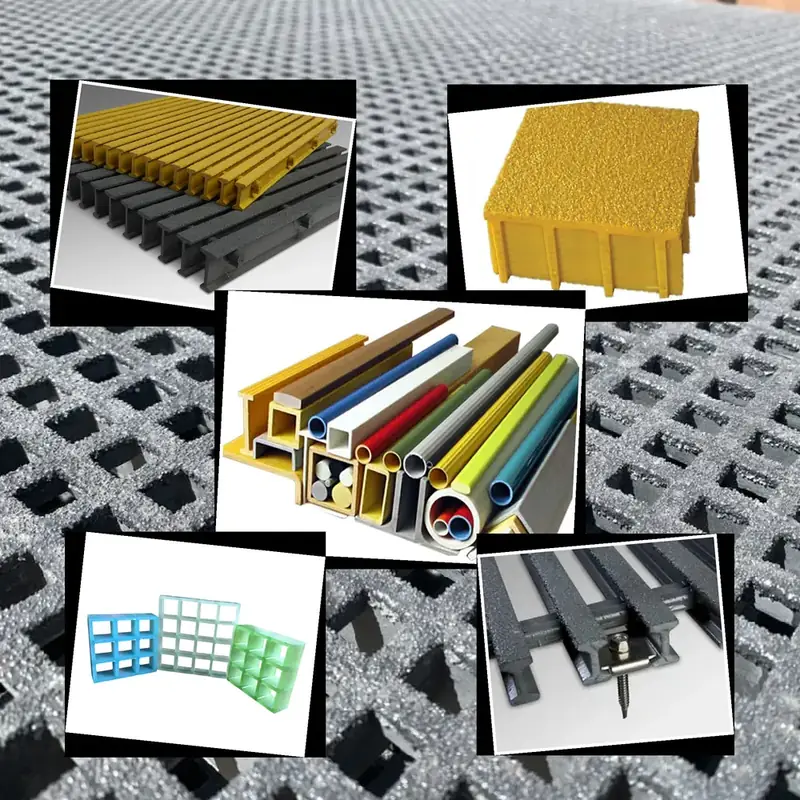
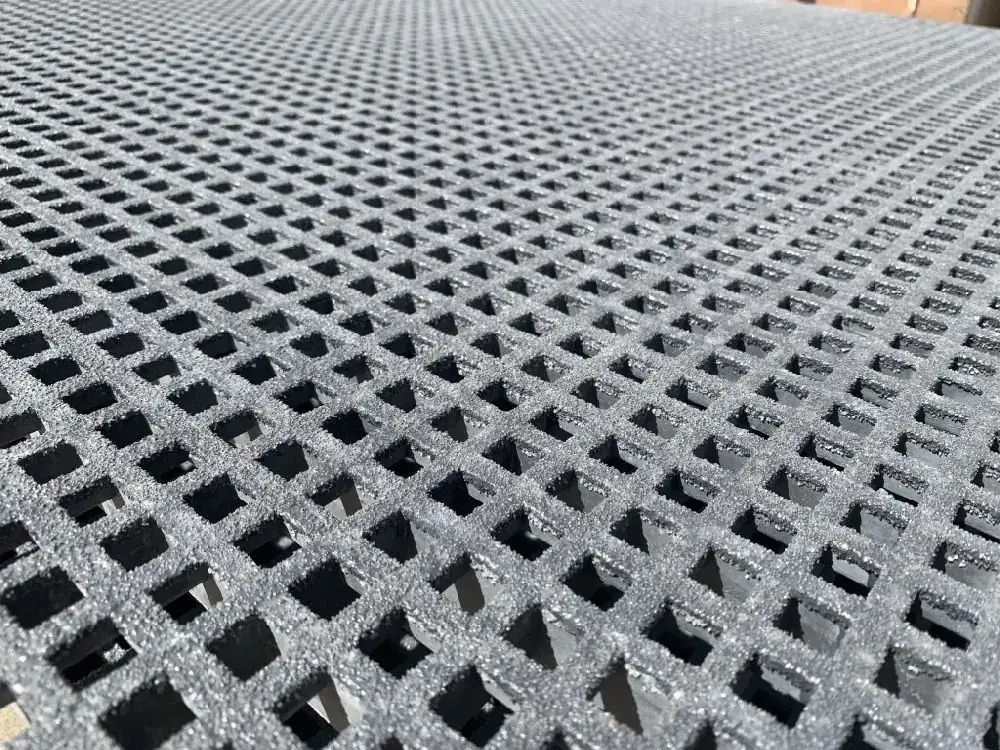
FRP (Fiberglass Reinforced Plastic) grating is a molded or pultruded fiberglass composite grid used for corrosion-resistant walkways, platforms and floorings. It combines glass fiber reinforcement with thermoset resin (polyester, vinyl ester, epoxy) for superior strength-to-weight ratio, zero rust and 20+ year service life.
It means the grating rests on supports at both ends with no fixed moment connection, and no load path continues across multiple spans. If your panels are welded or bolted continuously across several supports, the actual capacity differs from the table; ask the supplier for the multi-span rating.
L/200 is the standard for pedestrian walkways. Tighten to L/250 or L/300 when the platform supports sensitive instruments, process piping with flange joints, or finishes that cannot tolerate visible sag. Per project conditions, confirm with the structural engineer.
Do not convert casually. Wheel loads are concentrated and must be checked against the manufacturer's point-load rating, not the uniform-load table. If a point-load table is not available, request it from the supplier; do not scale the uniform number by the contact area.
Per project conditions. The table values are typically allowable loads already factored for a standard safety margin; do not apply an additional arbitrary factor on top without understanding what the table already includes. Confirm with the supplier and your structural engineer.
Ignore it for multi-span continuous panels, cantilevered ends, point-heavy wheel loads, impact or fatigue service, temperatures above resin limits, and any seismic or wind-driven load combination. These require a project-specific engineering calculation, not a table lookup.