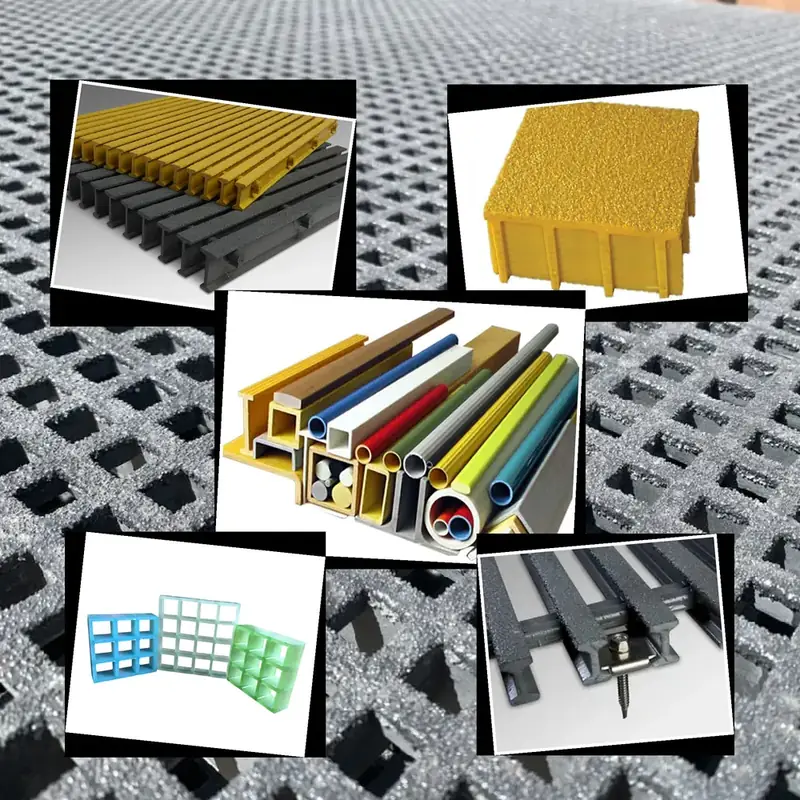
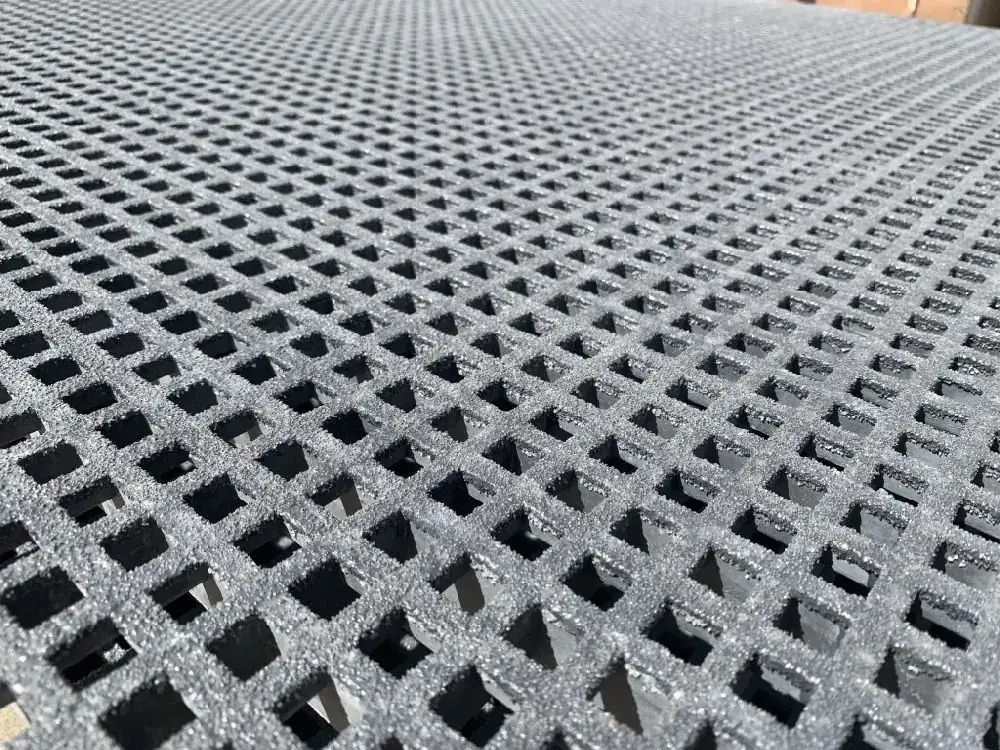
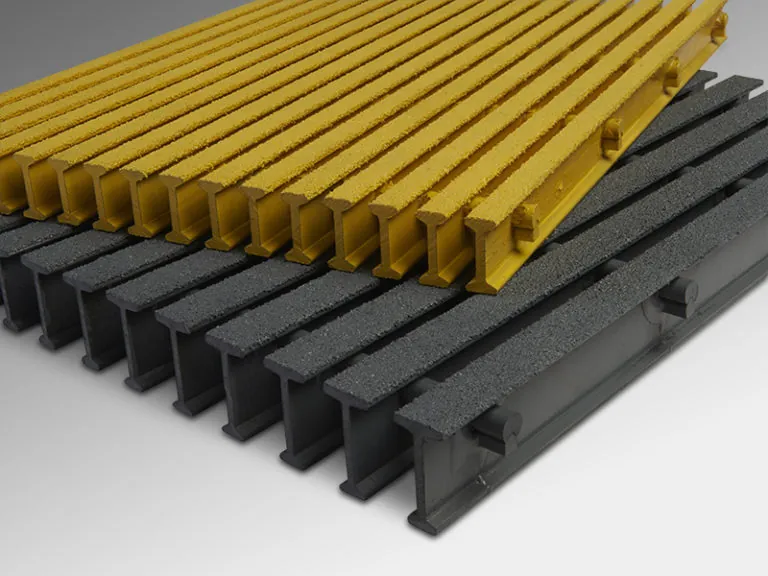
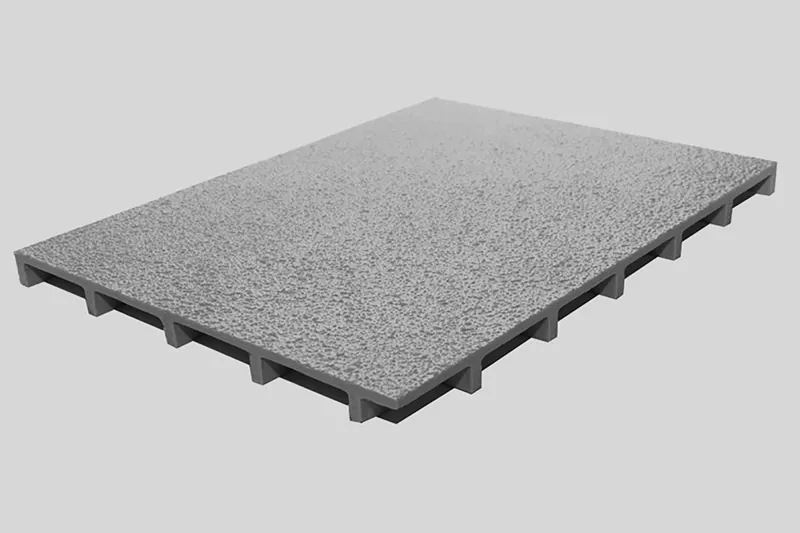
FRP beats steel on 20-year total cost of ownership in corrosive service: higher first cost (roughly $45–95/m² vs $35–50 for galvanized) is recovered by zero maintenance and no replacement.
- Best for: lifecycle-cost justification vs steel
- Choose FRP when: corrosion + maintenance cost dominate over 20 years
- Key spec: compare 20-yr TCO; molded isophthalic 38mm ~ $45–65/m²
1. Initial Material Cost Comparison (2026 Prices)
FRP Molded Grating (38mm, isophthalic): USD 45-65/m². FRP Pultruded Grating (50mm, vinyl ester): USD 65-95/m². Hot-Dip Galvanized Steel Grating (30×3mm bars): USD 35-50/m². Stainless Steel Grating (SS304): USD 110-160/m². Aluminum Grating (6063-T5): USD 70-100/m². Note: FRP initial cost is 20-40% higher than galvanized steel, but 30-50% lower than stainless steel. In corrosive environments where stainless steel is required, FRP offers significant initial cost savings. Price trends 2026: steel prices volatile (±15% due to energy costs), aluminum stable, FRP resin prices declining 3-5% due to overcapacity.
2. Installation Cost & Time Comparison
FRP Grating: 70-80% lighter than steel (15-20 kg/m² vs 40-60 kg/m²), 2-3 workers can install manually, no heavy equipment required, cutting with standard hand tools (jigsaw, circular saw), installation time 30-40% faster than steel. Steel Grating: requires lifting equipment (crane, forklift) for large panels, cutting requires torch or abrasive saw, heavier labor, installation time baseline 100%. Installation cost comparison (per 100m²): FRP USD 800-1,200, Steel USD 1,500-2,200, Aluminum USD 1,200-1,800. FRP saves 30-50% on installation labor and equipment costs.
3. Maintenance Cost Analysis (15-Year Period)
FRP Grating: zero maintenance required, no painting, no rust treatment, periodic cleaning with water only, maintenance cost USD 0-50/m² over 15 years. Galvanized Steel: requires inspection every 6 months, touch-up painting of damaged galvanizing every 2-3 years, full repainting every 5-7 years in corrosive environments, maintenance cost USD 150-300/m² over 15 years. Stainless Steel: minimal maintenance, but requires passivation and cleaning in chloride environments to prevent pitting, maintenance cost USD 50-100/m² over 15 years. In severe corrosion (coastal, chemical), steel maintenance costs can be 2-3x higher due to accelerated rusting.
4. Lifecycle Cost (LCC) Analysis — 20 Year Period
Total Cost of Ownership (TCO) per m² over 20 years, corrosive environment (coastal/chemical): FRP (vinyl ester): Initial 80 + Installation 10 + Maintenance 3 + Replacement 0 = USD 93/m². Galvanized Steel: Initial 45 + Installation 18 + Maintenance 45 + Replacement 60 (replaced at 10 years) = USD 168/m². Stainless Steel (SS304): Initial 135 + Installation 15 + Maintenance 8 + Replacement 0 = USD 158/m². Aluminum: Initial 85 + Installation 12 + Maintenance 18 + Replacement 40 (replaced at 15 years) = USD 155/m². FRP offers 40-45% lower TCO vs galvanized steel, and 40% lower vs stainless steel in corrosive environments. Payback period for FRP vs steel: 4-6 years through maintenance savings alone. ROI over 20 years: 150-200% for FRP in corrosive applications.
5. Performance Comparison & Application Recommendations
Corrosion Resistance: FRP (vinyl ester) > Stainless Steel > FRP (polyester) > Aluminum > Galvanized Steel. Weight: FRP (3-5 kg/m²) < Aluminum (8-12 kg/m²) < Steel (20-30 kg/m²). Load Capacity: Steel > Aluminum > FRP (pultruded) > FRP (molded). Fire Performance: Steel (non-combustible) > Aluminum (melts at 660°C) > FRP (phenolic fire-retardant, self-extinguishing). Electrical Insulation: FRP (excellent, non-conductive) > Aluminum (conductive) > Steel (conductive). Application Recommendations: Chemical plants, wastewater, coastal — FRP (vinyl ester) best value. Indoor, dry, non-corrosive — galvanized steel lowest initial cost. Food/pharma, clean rooms — stainless steel or FRP (smooth surface). High load, heavy traffic — steel or pultruded FRP (heavy-duty). Electrical substations — FRP (non-conductive, safety advantage).
6. When Steel Makes Sense vs When FRP is Better
Choose Steel when: very high loads (>25 kN/m²), indoor dry environment, initial budget is primary concern, project lifespan <5 years. Choose FRP when: corrosive environment (chemical, coastal, wastewater), weight is critical (rooftops, existing structures), electrical safety required, low maintenance desired, lifespan >10 years, total cost of ownership matters. The break-even point for FRP vs galvanized steel is typically 4-6 years in moderate corrosion, 2-3 years in severe corrosion. After break-even, FRP saves money every year through eliminated maintenance and replacement costs.
TCO Calculation Basis: Three Sensitivity Variables
A 20-year TCO number is only as credible as the assumptions behind it. Three variables move the FRP-vs-steel result more than any supplier list price: the discount rate, the steel recoating cycle, and the number of steel replacements over the horizon. Run the model at a baseline and a stress case before you sign off.
The table below fixes the engineering logic; the actual numbers are per project conditions. The point is not to pick a 'right' rate, but to see which direction each variable pushes the comparison and how wide the band gets.
Sensitivity of FRP-vs-steel TCO to three key variables
| Variable | Baseline Assumption | Stress Case | Effect on FRP-vs-Steel TCO |
|---|---|---|---|
| Discount rate | Per project conditions | High discount (8–10 %) | Favors steel: future FRP savings discounted harder |
| Steel recoating cycle | Recoat every 8–10 yrs in atmospheric use | Recoat every 5 yrs in corrosive service | Strongly favors FRP |
| Steel replacements over 20 yrs | One replacement at mid-life | Two replacements; FRP zero | Strongly favors FRP |
| Site labor rate | Standard industrial rate | Remote site / shutdown premium | Favors FRP: light install, no hot work |
| Resin upgrade | Isophthalic standard | Vinyl ester for immersion | Narrows FRP price gap, preserves TCO edge |
Boundary Conditions Where Steel Is the Cheaper Choice
FRP does not win every TCO comparison. There are four defensible boundary conditions where hot-dip galvanized steel remains the lower-cost option over 20 years, and one temporary-works case where it wins outright. Knowing where steel still wins keeps the FRP recommendation credible instead of ideological.
Use these boundaries as a screen: if your project lands inside one of them, do not force FRP. If it lands outside, the steel quote almost certainly hides a maintenance or shutdown line that will surface later.
- Fully dry atmospheric service with no acid, chloride, or splash — recoating stays on the long cycle and FRP's corrosion advantage is not bought.
- Extremely heavy point loads beyond molded FRP ratings, where pultruded FRP becomes more expensive than steel for the same capacity.
- Temporary works under five years — the 20-year TCO horizon never arrives, and upfront cost dominates.
- Sites where lifting crews and hot-work permits are already mobilized for other steelwork — FRP's install advantage is already being paid for by someone else.
- Budget-constrained projects with a planned replacement cycle, where the client explicitly accepts steel recoating and shutdowns.
Frequently Asked Questions
FRP (Fiberglass Reinforced Plastic) grating is a molded or pultruded fiberglass composite grid used for corrosion-resistant walkways, platforms and floorings. It combines glass fiber reinforcement with thermoset resin (polyester, vinyl ester, epoxy) for superior strength-to-weight ratio, zero rust and 20+ year service life.
Use the rate your finance team already applies to capital projects; do not invent one. A higher discount rate favors upfront-cheaper steel, while a lower rate rewards FRP's long maintenance-free years. Run the model at ±2 % around the corporate rate before deciding.
In atmospheric service, hot-dip galvanized steel may reach 15 years; in acid, chloride, or H2S service, pitting can force replacement inside 8–10 years. Per project conditions, plan at least one mid-life replacement for steel in corrosive zones and compare that number directly.
Yes, in four cases: fully dry atmospheric service with no coating pressure; very short-term temporary use under five years; extremely heavy point loads beyond molded ratings; and sites where hot work and lifting are already mobilized for other steelwork.
Vendors quote either material cost or installed cost, rarely both. Steel quotes often exclude touch-up painting and recoating labor; FRP quotes exclude resin-grade upgrades. Always compare apples to apples: same coating, same access method, same shutdown window.
Highly sensitive on retrofits. FRP panels are light enough for a two-person lift, while steel needs rigging and welding crews. On offshore or remote sites where shutdown labor is priced at a premium, FRP's installed-cost advantage widens even if raw m² is higher.