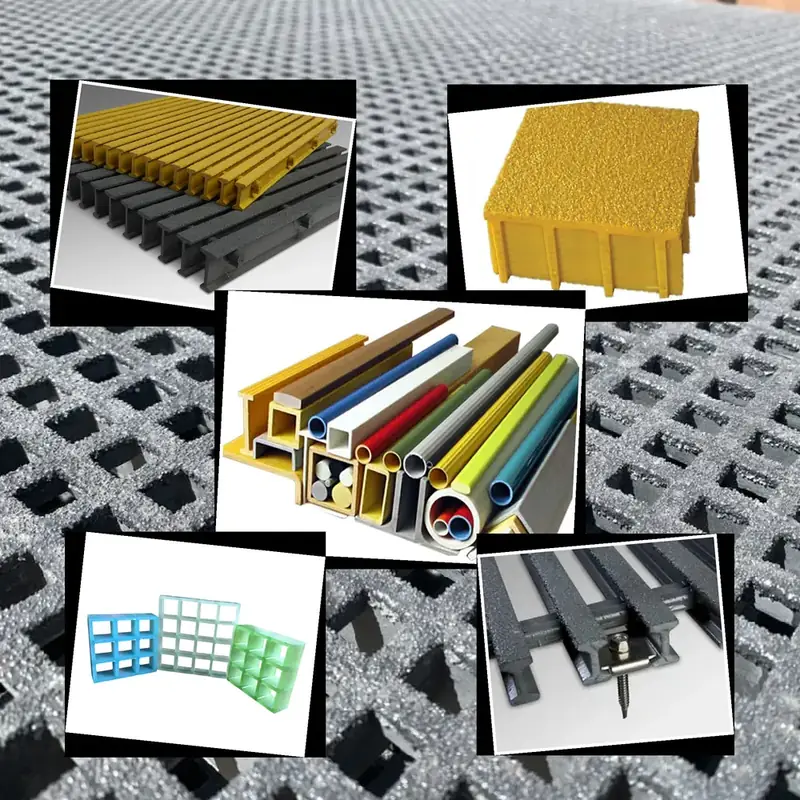
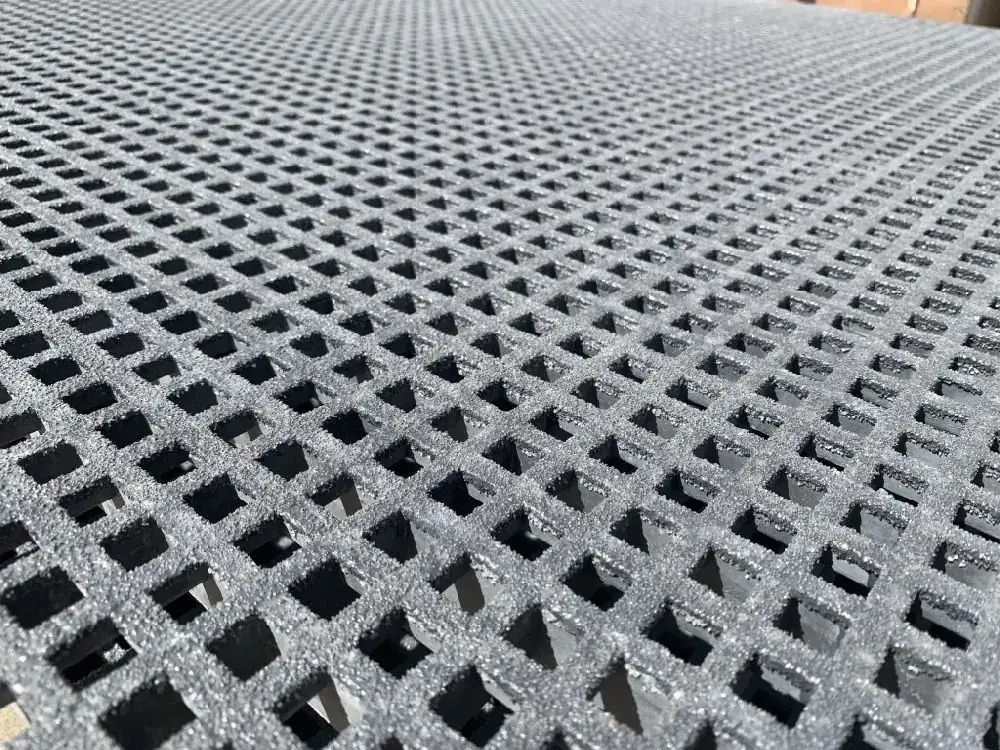
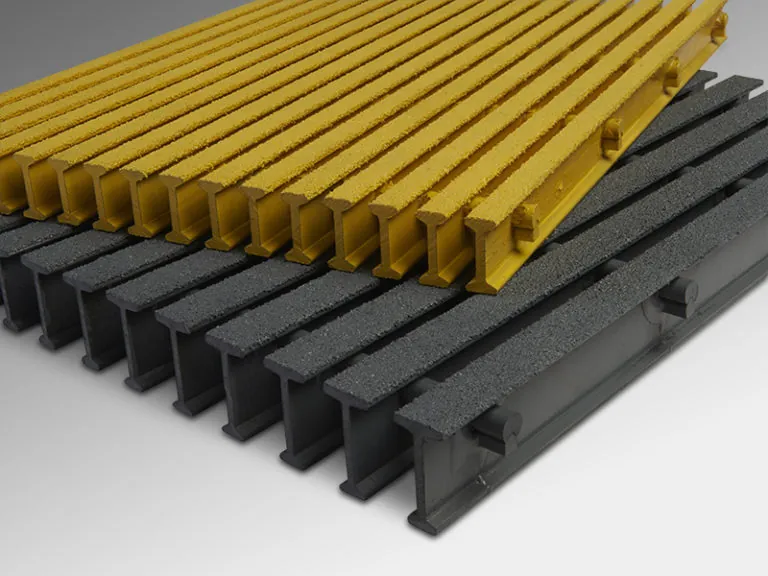
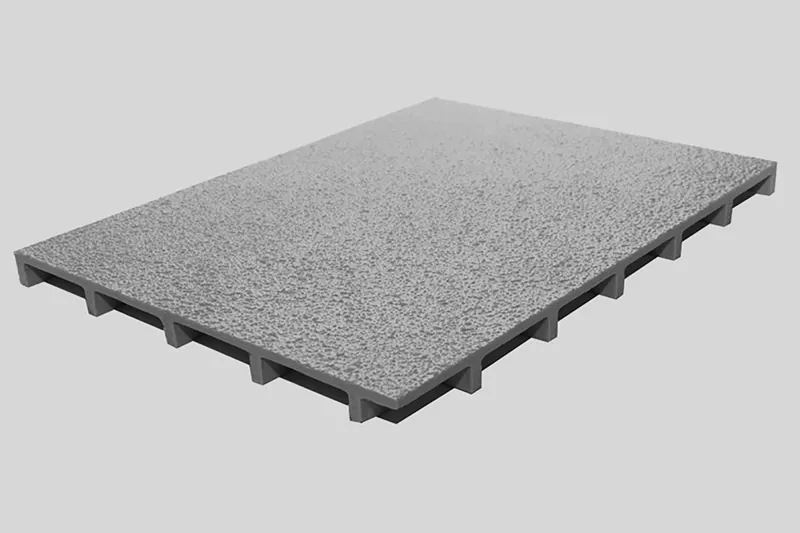
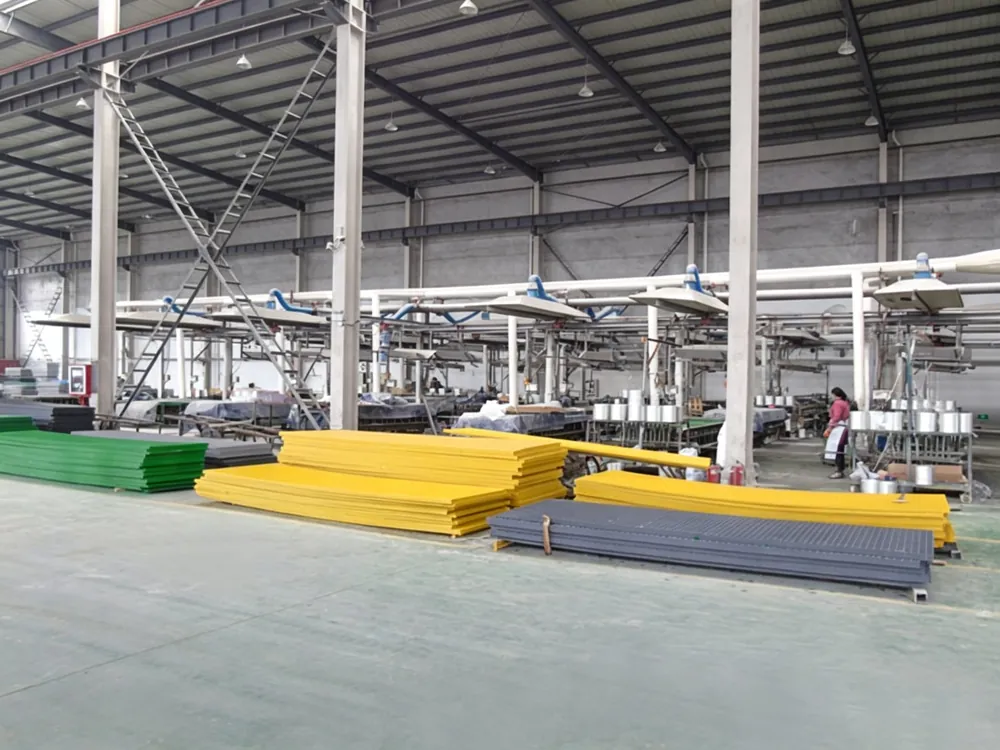
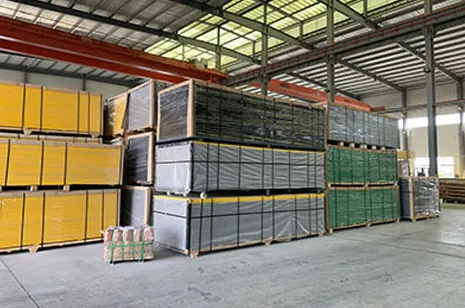
Molded FRP grating is cast from continuous glass strands and resin into a one-piece panel — cost-effective, corrosion-proof and strong enough for most industrial walkways.
- Best for: standard walkways, platforms and covers
- Choose molded for: low-cost corrosion-resistant flooring
- Key spec: ASTM load class, isophthalic resin, 25–50 mm
1. Manufacturing Process Overview
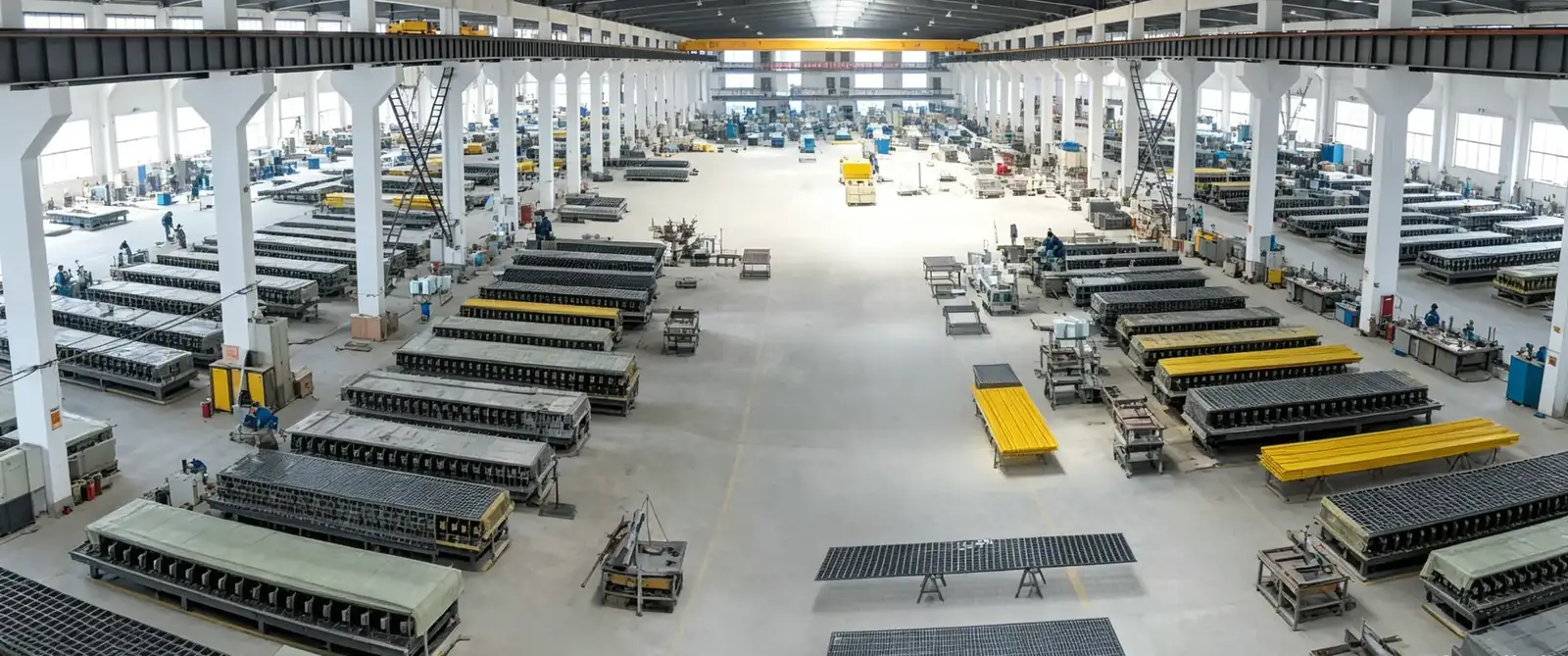
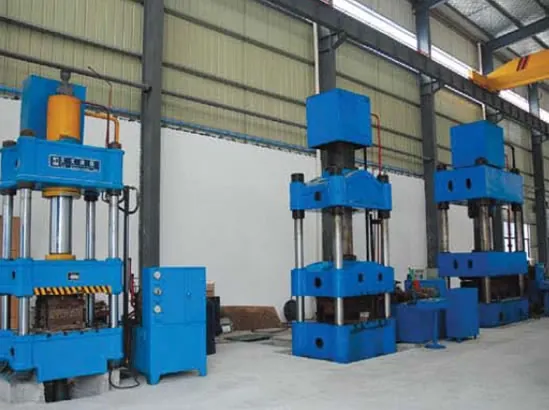
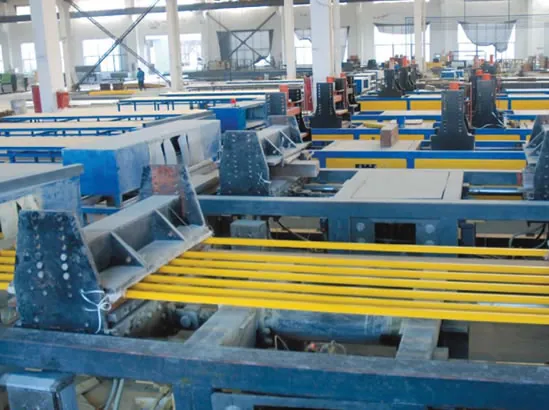
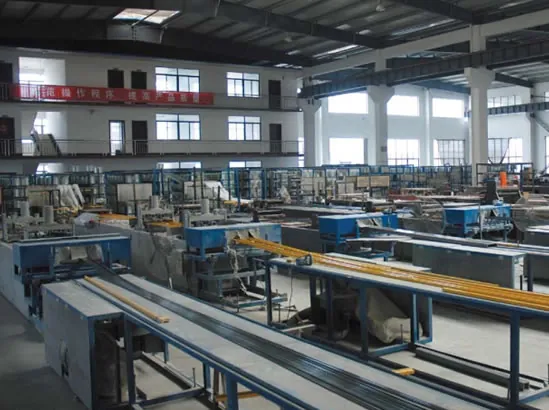
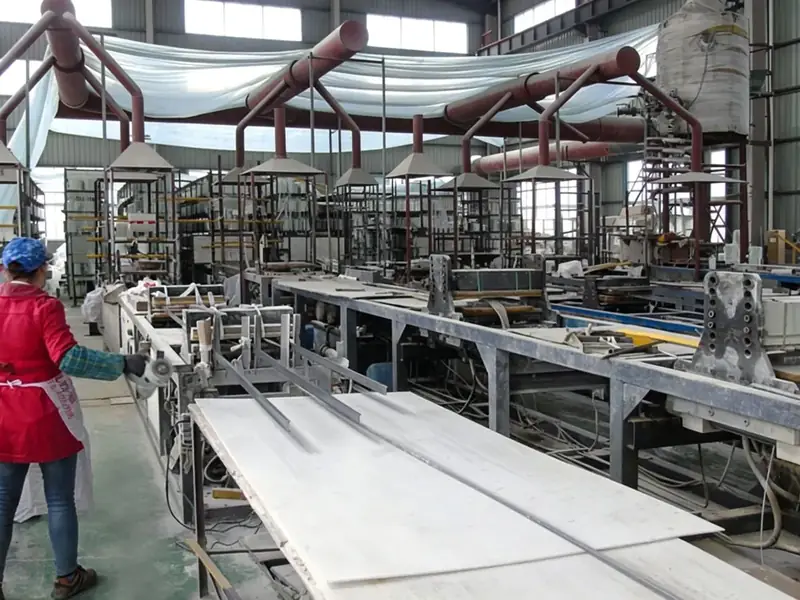
FRP molded grating is manufactured by casting continuous glass fiber strands and thermosetting resin in precision-heated metal molds. The process creates a one-piece, integrated grid structure with bidirectional strength. Key manufacturing parameters include mold temperature (140-160°C), curing time (8-15 minutes), resin injection pressure (2-4 bar), and glass fiber content (60-65% by weight).
2. Material Specifications & Standards
Standard molded grating panels are 1220mm × 3660mm, with thickness options of 25mm, 30mm, 38mm, and 50mm. Mesh sizes are typically 38×38mm or 40×40mm square opening. Resin systems include general-purpose polyester (ASTM D3299), isophthalic polyester (ASTM D3567), and vinyl ester (ASTM D4162). Glass fiber types include E-glass (electrical grade) and C-glass (chemical grade).
3. Mechanical Performance Data
38mm thick molded grating with 38×38mm mesh typically achieves: bending strength 180-220 MPa, tensile strength 280-320 MPa, compressive strength 120-150 MPa, elastic modulus 12-15 GPa, and Barcol hardness 40-50. Load capacity at 600mm span: pedestrian load 5 kN/m², medium load 10 kN/m², heavy load 15 kN/m². Deflection limit is typically L/200 per industrial standards.
4. Corrosion Resistance Performance
Vinyl ester molded grating demonstrates excellent resistance to 50% sulfuric acid (weight loss <2% after 90 days immersion), 30% sodium hydroxide (<1.5% weight loss), and most organic solvents. Isophthalic polyester performs well in mild to moderate chemical environments. Operating temperature range: -40°C to +80°C continuous, with intermittent exposure up to 120°C for vinyl ester systems.
5. 2026 Global Market Analysis
The global FRP molded grating market is projected to reach USD 1.85 billion by 2026, growing at a CAGR of 6.2% from 2024. Key growth drivers include: infrastructure modernization in developing economies, replacement of corroded steel grating in chemical plants, increasing demand from wastewater treatment sector, and growing adoption in renewable energy projects (solar farm walkways). Asia-Pacific dominates with 42% market share, followed by North America (28%) and Europe (20%).
Design Standards & Data Basis
All load, span and capacity values in this article are typical/indicative, derived from laboratory tests per NAAMM MBG-01 (FRP Grating Design Manual) methodology. Molded grating values apply a 5:1 factor of safety on ultimate capacity; pultruded grating values apply a 3:1 factor of safety, both measured at static ambient conditions. Impact loads are limited to 50% of stated values; long-term loads require creep adjustment per ASCE Structural Plastics Design Manual. Certified load tables, stamped engineering calculations and third-party test reports are available on request.
For structural sizing of your specific application, contact our engineering team with your load requirements, span and environmental conditions — we provide free structural calculations within 24 hours. Browse our molded grating and pultruded grating product pages for full specifications and resin options.
Typical Allowable Uniform Load (kN/m²) - Molded Grating
The table below consolidates typical allowable uniform live loads for molded isophthalic / vinyl-ester grating at a deflection limit of L/200, with a 5:1 factor of safety on ultimate capacity. Values are typical/indicative per NAAMM MBG-01; certified load tables are available on request.
| Model | Span 600 mm | Span 800 mm | Span 1000 mm | Span 1200 mm | Span 1500 mm |
|---|---|---|---|---|---|
| FG-M2538 (25 mm x 38x38) | 2.5-3.5 | 1.8-2.5 | 1.2-1.8 | 0.8-1.2 | 0.5-0.8 |
| FG-M3038 (30 mm x 38x38) | 4.0-5.0 | 2.8-3.8 | 2.0-2.8 | 1.4-2.0 | 0.9-1.4 |
| FG-M3838 (38 mm x 38x38) | 5.5-7.0 | 4.0-5.0 | 3.0-4.0 | 2.2-3.0 | 1.5-2.2 |
| FG-M3819 (38 mm x 19x19) | 6.5-8.0 | 4.8-6.0 | 3.6-4.6 | 2.6-3.5 | 1.8-2.6 |
| FG-M5038 (50 mm x 38x38) | 9-12 | 6.5-8.5 | 5.0-6.5 | 3.8-5.0 | 2.6-3.6 |
Typical/indicative values per NAAMM MBG-01; certified table on request. Ranges reflect resin system, mesh tolerance and fabrication variation. For forklift or truck traffic, use pultruded I-bar grating.
Model Naming: Thickness x Mesh Reference
ZEALL molded FRP grating is designated by panel thickness x mesh opening. The standard catalog covers four depths (25 / 30 / 38 / 50 mm) and three mesh sizes (38x38, 19x19, 50x50 mm). A typical designation is "38 mm Molded Grating x 38x38 mm mesh" (model code FG-M3838). Common references:
| Model code | Thickness | Mesh | Duty class | Typical use |
|---|---|---|---|---|
| FG-M2538 | 25 mm | 38x38 mm | Light | Drainage covers, light walkways |
| FG-M3038 | 30 mm | 38x38 mm | Medium | General walkways, ramps |
| FG-M3838 | 38 mm | 38x38 mm | Standard | Industrial platforms, standard service |
| FG-M3819 | 38 mm | 19x19 mm | Standard mini-mesh | Tool handling, heel-safe walkways |
| FG-M5038 | 50 mm | 38x38 mm | Heavy | Forklift areas, long spans |
| FG-P5038 | 50 mm I-bar | 38 mm bar spacing | Heavy pultruded | Heavy-duty platforms, truck traffic |
Typical Structural Parameters (I / S / E)
The table below gives typical flexural stiffness ranges for FRP grating profiles. Values are typical per NAAMM MBG-01 and are not a substitute for a certified mill test report. E depends on resin system (isophthalic polyester approx. 10-12 GPa; vinyl ester approx. 12-15 GPa); I and S scale with bar depth and profile shape.
| Profile | E flexural (GPa) | I (cm⁴ / m width) | S (cm³ / m width) |
|---|---|---|---|
| 25 mm molded grid | 10-12 | 2.5-4.0 | 2.0-3.2 |
| 30 mm molded grid | 10-12 | 4.5-7.0 | 3.2-4.8 |
| 38 mm molded grid | 11-13 | 8-13 | 5.0-7.5 |
| 50 mm molded grid | 11-14 | 16-26 | 8.5-13 |
| 50 mm I-bar pultruded | 12-15 | 55-85 | 22-32 |
Typical values per NAAMM MBG-01; certified values per project-specific mill test report on request.
Browse our product pages for full specifications: FRP molded grating.
Molded Series: Six Density Grades and Open Area
Molded FRP grating is not one product — it is six density grades, each with its own mass per area, open area, and typical span window. Picking the grade by thickness alone is a common mistake; the mass and open area decide both the weight you are lifting and the wind, light and slip behavior on the platform.
The six tiers below are the standard molded series at our 20,000+ m² factory (founded 2004, 200+ staff). Use them as the reference frame when a supplier quotes a figure that does not line up — the discrepancy usually comes from a different mesh or a resin-rich overlay, not from a 'better' panel.
Standard molded FRP series: thickness, mass per area, open area
| Thickness | Mass per Area | Open Area | Typical Use | Span Window |
|---|---|---|---|---|
| 25 mm | 12.5 kg/m² | 68 % | Light walkways, cable tray covers | Short spans |
| 30 mm | 15.0 kg/m² | 66 % | Standard foot traffic platforms | Moderate spans |
| 38 mm | 19.5 kg/m² | 68 % | General industrial duty | Most common grade |
| 38 × 40 mm (bar overlay) | 18.0 kg/m² | 70 % | Wear surface, anti-slip overlay | Same span as 38 mm |
| 50 mm | 27.0 kg/m² | 60 % | Heavy duty, light vehicle access | Longer spans |
| 65 HD | 38.0 kg/m² | 56 % | Heaviest molded duty | Longest molded spans |
Molding, Demolding and Mass-per-Area Acceptance
A molded panel is only as good as the resin-rich layer on top of it. The molding process lays continuous glass strands in two directions, saturates them with resin, and cures under heat; the demolding step decides whether that resin-rich surface stays intact or delaminates on the way out.
Acceptance on site should not stop at visual. Three quick checks — mass per area, Barcol hardness, and a tap test — catch the most common molding deviations before the panel is installed.
- Mass per area: weigh a 1 m² sample and compare to the grade above; large deviations usually mean resin-rich or fiber-poor layers. Tolerance per project conditions.
- Barcol hardness: a portable meter should read ≥ 40 on the top surface; a low reading points to under-cure.
- Density: typical molded FRP sits at 1.5–2.0 g/cm³; a much lighter panel usually hides voids.
- Resin-rich top layer: must cover the glass weave evenly; exposed strands are a reject, not a touch-up.
Common Molding Defects and Disposition
Most field failures of molded FRP are not load failures — they are molding defects that shipped under inspection. The table below lists the five defects that actually reach site, the visible sign, the likely cause, and the disposition. Use it as a receiving-inspection checklist.
A defect on the surface is also a defect through the section: a resin-starved top layer means the corrosion barrier is gone, even if the panel still passes a simple load tap test.
Common molded-grating defects, signs, causes and disposition
| Defect | Visible Sign | Likely Cause | Disposition |
|---|---|---|---|
| Resin starvation | Exposed glass fibers on top surface | Insufficient resin or fast cure | Reject; corrosion barrier lost |
| Dry glass / voids | Hollow spots under tap test | Incomplete wet-out in mold | Reject; structural concern |
| Warpage out of flat | Curved panel, gap on supports | Uneven cooling or release | Reject beyond tolerance per project |
| Surface blister | Raised air pocket under gel coat | Trapped air during molding | Repair or reject per project |
| Uneven mesh | Irregular bar spacing | Mold wear or misalignment | Reject; load rating not guaranteed |
Frequently Asked Questions
FRP (Fiberglass Reinforced Plastic) grating is a molded or pultruded fiberglass composite grid used for corrosion-resistant walkways, platforms and floorings. It combines glass fiber reinforcement with thermoset resin (polyester, vinyl ester, epoxy) for superior strength-to-weight ratio, zero rust and 20+ year service life.
The six tiers above are the standard molded series at our factory. If a supplier quotes a figure outside them, ask for the resin type, fiber architecture, and mesh size — mass alone is not comparable across different mesh openings. Reconcile against open area, not just kg/m².
Confirm per project conditions; a tight batch-to-batch tolerance is expected because the molding process is fixed-cycle. As a practical QA step, weigh a 1 m² sample and compare to the grade above; large deviations usually mean resin-rich or fiber-poor layers.
The 38 × 40 mm grade uses a bar-overlay wear surface with a different mesh geometry; its open area is higher (70 %) and mass lower (18.0 kg/m²) than the standard 38 mm (19.5 kg/m²). It is not a lighter 38 mm — it is a different product for anti-slip wear surfaces.
Run three checks: Barcol hardness (≥ 40), a visual scan for exposed glass or dry spots, and a tap test for hollow voids. A properly molded panel has a uniform resin-rich surface, consistent mesh spacing, and no audible hollow spots when tapped.
Yes. Open area drives weight, wind load, light transmission, and slip resistance. Higher open area (e.g., 70 %) means lighter panels and better ventilation but lower mass per area; lower open area (e.g., 56 % at 65 HD) means heavier, stronger panels for long spans and heavy loads.